Kiruna to Luleå (163 miles)
 I returned to my Ferrum hotel room to sleep for a few of hours, after Kurt left for work at 5am. Donna and I then shared a leisurely, silent, breakfast before we boarded the 10am train to Luleå on the
by kind courtesy of www.worldatlas.com

My companion did not say much at all during that trip. And I was simply too tired to ask why. Discovering the reason for her lack of conversation would have to wait until I'd slept off the rigours of the previous night.
At 2.30pm we arrived at Luleå (Loo-lay-oh) a university city on the coast of northern Sweden, not far from the border with Finland.
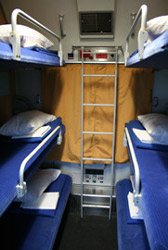
 Our overnight train connection to Stockholm was not due to leave till 9 pm. So Donna and I secured our couchettes for later, stowed our packs in the station lockers for the day and then decided to spend a few hours apart from each other.
Ostensibly, we would later be able to share our individual experiences during the long journey to Stockholm. But, privately, I knew we both required an extended 'time-out' from each other.

by kind courtesy of www.newfriends.se
 Our overnight train connection to Stockholm was not due to leave till 9 pm. So Donna and I secured our couchettes for later, stowed our packs in the station lockers for the day and then decided to spend a few hours apart from each other.
 Ostensibly, we would later be able to share our individual experiences during the long journey to Stockholm. But, privately, I knew we both required an extended 'time-out' from each other.

by kind courtesy of

There are always changing temporary exhibitions on display, many in the fields of contemporary art, photography and local cultural history. Permanent collections deal with archaeological finds and the history of the area.
The main building in Luleå was built in 1936, but the museum has projects all over the north involving archeology, archive and photo, documentation, art, cultural tourism and education.
I enjoyed the detailed archeological history of the area. And the simple yet vivid Lapp history that lives on through their weaving and domestic crafts warmed my heart. A nation that preserves, with such care, the contributions of their ancestors, teaches its children the true value of family.
by kind courtesy of: www.potolkimaker.com

Its shops were modern, and the people on the street were conservative and quiet in both dress and manner. The town seemed to have escaped the social chaos of the 60s and early 70s.
Buildings seemed purpose-built to withstand the extremes of weather. And I especially admired the civic common sense that provided a sheltered boardwalk, alongside but, necessarily, higher than the road. Pedestrians thus have access to shops throughout the heaviest snowfalls of Luleå's long, dark winters.
The Gulf of Bothnia borders at the eastern edge of Luleå. Here, I selected a sun-warmed rock upon which I sat cross-legged and meditated for an hour. Listening to the waters lapping against the rocks whilst breathing in the heavenly aroma of flowers that emanated from this unexpected jewel of a town was a real pleasure. And being happily alone in my reverie was an added bonus.
BEAUTIFUL LULEA
by kind courtesy of www.isep.org

On that first full day of summer, however, flowers bloomed in the smallest nooks and crannies of that little seaside town. And their sweet fragrance continue to waft into memory, beckoning me back to Luleå.
Donna and I were later reunited on the station platform in plenty of time to board the overnight sleeper. We had both stocked up on food and drinks, since we had discovered that the journey back to Stockholm would take 16 hours or more.
Tuesday June 22:
Luleå to Stockholm (521 miles)
Donna and I were later reunited on the station platform in plenty of time to board the overnight sleeper. We had both stocked up on food and drinks, since we had discovered that the journey back to Stockholm would take 16 hours or more.
The long, bright evening, played havoc with my internal clock, so I spent much of the night awake. It gave me the opportunity to write up my journal, after which I found a way to get some air.
Precariously perched between the moving carriages, I enjoyed the breeze created by the moving train, and listened, for a while, to the clickety-clack of the rails.
EURAIL THROUGH SWEDEN
by kind courtesy of http://www.eurail.com/trains-europe/trains-country/trains-sweden
by kind courtesy of http://www.eurail.com/trains-europe/trains-country/trains-sweden

The train travelled almost due southwards through Norbotten. The scenery changed only gradually, the dry winds and treeless mountains of this northern zone resembling those of Dornoch on the North East coast of Scotland.

But this open landscape yielded first to evergreens, then to birch forests and finally, to well-tended farms and larger towns. Sweden's traditional red houses, with steep pitched roofs, were in evidence throughout the country.
TRADITIONAL SWEDISH RED HOUSE
by kind courtesy of commons.wikimedia.org

This warm, floral greeting from one household to another was a visible overture of friendship. It took time and effort to produce such gardens.
I applaud their dedication and found the results as tender as they were was stylish. But this combination of soft yet strong, distant yet welcoming, sensitive yet stylish is - as I was learning - typical of Swedes. When they can neither see nor touch those with whom they are connecting, they simply utilize their remaining senses to explore alternate ways of communicating.
After eight uninterrupted hours of sleep on the train, Donna and I reached Stockholm at 1pm in fair condition. Since we would catch the overnight train to Oslo that same night, we again parked our back-packs in the station lockers. Then we reserved our couchettes and headed out for the day.
 Wednesday June 23 1pm: Stockholm
Our attempt to tour Stockholm without a guide was a totally disastrous experience! Happy to be walking instead of riding in a train, we had wandered through the city streets, and soon become hopelessly lost. Happily a friendly Frenchman helped us to choose a tour, then gave me his phone number and address in Paris, for whenever we arrived there!
STOCKHOLM FROM THE HARBOUR
by kind courtesy of http://www.tripadvisor.com/Tourism-g189852-Stockholm-Vacations.html
by kind courtesy of http://www.tripadvisor.com/Tourism-g189852-Stockholm-Vacations.html

We finally decided to take a Canal and Harbour Tour of Stockholm, ending at the Vasa Museum.
The view of the city from the vantage point of a canal cruise is not to be missed. Donna seemed to have shaken off her depression. And we had come to a wordless truce upon stepping off the train at Stockholm.

The view of the city from the vantage point of a canal cruise is not to be missed. Donna seemed to have shaken off her depression. And we had come to a wordless truce upon stepping off the train at Stockholm.
Truce is good!!
MODEL OF THE VASA
by kind courtesy of commons.wikimedia.org/wiki/File:Vasa_stern_color_model.jpg
by kind courtesy of commons.wikimedia.org/wiki/File:Vasa_stern_color_model.jpg

We were standing in front of the original timbers of an ancient Viking warship.
The Vasa is the world's oldest boat, and was dredged up from the bottom of Stockholm harbour in 1961.
Built in 1628, the Vasa was designed to be the jewel of Sweden's navy. BUT, on the very day it was launched, it tragically sank, right in front of a cheering crowd of thousands.
There is still something haunting about this ship, perched on its stand inside the museum, bristling with hundreds of baroque carvings, and the massive guns that dragged it to its watery death.
Now reclaimed from the watery grave, the Vasa currently resides in its own specially-built edifice. The humidity level within this museum is kept uncomfortably high, to preserve the centuries' old timbers. Without this important precaution, the ancient wood would disintegrate and turn to dust.
After Vasa, Donna and I amicably decided to go our separate ways for the day. Solo exploration was no hardship for me, especially since I had originally intended on taking this trip solo. I find it easier to know my true responses to new places when I am completely alone. Of course, being alone in Europe was not going to be easy. Especially with a travelling companion in tow.
Donna was a colleague whom I had known only peripherally, until the day she 'decided' she would 'join me' on my carefully planned, and much anticipated, solo Grand Tour of Europe. At first her decision thoroughly irritated me. But, eventually, I reasoned that sharing lodging and some food expenses might lessen both of our expenses. With little fanfare, my plan to travel solo was thus expanded to include another.
My Mother had been ecstatic that I would not be travelling the length and breadth of Europe alone. And since Donna spent most of her travelling hours reading, she was hardly much of an imposition. We had only ever been professional acquaintances, never friends, so it was inevitable that our personalities might clash from time to time.
And clash they did for the frenetic pace of our first four days of travelling together, though exciting, had also been stressful. It was inevitable that cracks would appear in our relationship. Donna and I had grown up in different worlds, and had radically different approaches to life and how to live it.


"Djurgarden", an original painting by Marcus Forslund, perfectly captures the translucent greens and carefree spirit of Djurgarden for me.
WALDEMARSUDDE
Home of Sweden's "Painter" Prince
Donna was a colleague whom I had known only peripherally, until the day she 'decided' she would 'join me' on my carefully planned, and much anticipated, solo Grand Tour of Europe. At first her decision thoroughly irritated me. But, eventually, I reasoned that sharing lodging and some food expenses might lessen both of our expenses. With little fanfare, my plan to travel solo was thus expanded to include another.
My Mother had been ecstatic that I would not be travelling the length and breadth of Europe alone. And since Donna spent most of her travelling hours reading, she was hardly much of an imposition. We had only ever been professional acquaintances, never friends, so it was inevitable that our personalities might clash from time to time.
And clash they did for the frenetic pace of our first four days of travelling together, though exciting, had also been stressful. It was inevitable that cracks would appear in our relationship. Donna and I had grown up in different worlds, and had radically different approaches to life and how to live it.
by kind courtesy of motivationalplus.com
My purpose in travelling was two-fold:
- to know each nation's soul through its contributions to its citizens and humanity via SCience, the Arts, Edu-ca-tion and Architecture.
- to learn new ideas and customs through interactions with dwellers and other travellers.
I had no idea why Donna was travelling.
I suspected that this trip would test us both to the core. It would either cement our friendship or we would part ways, never to meet again. And, oddly, I was ambivalent about the outcome.
DJURGARDEN
After we separated at the steamy Vasa museum, I thoroughly enjoyed the warm, breezy walk through the leafy pathways of Djurgarden. With nobody else around, I focused on the intense colours of the leaves and grasses on the banks of the stream, wondering what made them so incredibly vibrant.
I concluded that the same shallow angle of the sun in these northern latitudes that permits almost 24 hour of summertime sunshine, alters the way in which our eyes see colour. We get the same effect at lower latitudes but it is only at sunrise and sunset that sunlight slants in on the same shallow angle. But the light levels in the mid-latitude sunset and sunrise are far weaker than those that created the brightly glowing greens I witnessed that afternoon in Djurgarden.
I concluded that the same shallow angle of the sun in these northern latitudes that permits almost 24 hour of summertime sunshine, alters the way in which our eyes see colour. We get the same effect at lower latitudes but it is only at sunrise and sunset that sunlight slants in on the same shallow angle. But the light levels in the mid-latitude sunset and sunrise are far weaker than those that created the brightly glowing greens I witnessed that afternoon in Djurgarden.
My spirit felt very peaceful in this place of magical light and bright translucent colour.
Even the songbirds were happy and the whole forest was alive with sound. So, when I was sure no-one could hear me, I whistled a song back to them. Then I remained very still, as a curious male thrush hopped into view to check out the even more curious human who was singing to him.
Although it was once the game park that fed the household of Sweden's Royalty, Djurgarden was donated to the government in 1948. It is now open for everyone to wander through and enjoy, and is a delightful place in which to unwind during the early summertime.
Although it was once the game park that fed the household of Sweden's Royalty, Djurgarden was donated to the government in 1948. It is now open for everyone to wander through and enjoy, and is a delightful place in which to unwind during the early summertime.
by kind courtesy of www.galleryforslund.com/webshop.htm

"Djurgarden", an original painting by Marcus Forslund, perfectly captures the translucent greens and carefree spirit of Djurgarden for me.
Standing proudly at the edge of The Baltic Sea in the grounds of Djurgarden is
WALDEMARSUDDE
Home of Sweden's "Painter" Prince
by kind courtesy of panoramio/photos/medium/63389301.jpg

The youngest of Oscar II's four children, Prince Eugen (1865-1947) was more interested in becoming an artist than in inheriting the throne. Turns out he was no Sunday painter; he became one of the great landscape artists of his day, referred to as the "The Painter Prince" by Swedes. Today, his former home and studio, one of the most visited museums in Sweden, serves as an art gallery and a memorial to his talents.
This lovely three-story mansion on the water was acquired by the prince in 1899, and he lived here until his death. The house and park were willed to the Swedish government upon his death and opened to the public in 1948. The rooms on the ground floor are furnished just as the prince left them. You can see the prince's paintings upstairs and in the gallery adjoining. The prince was not only a painter, but a collector, acquiring works by such great Scandinavian artists as Edvard Munch, Carl Larsson, and Anders Zorn. The prince's studio is on the top floor and is used for temporary exhibitions.
The garden has centuries-old trees and panoramic views of Stockholm harbour. That's not all: The park is filled with sculptures by some of the greatest masters in Europe -- Carl Milles to Auguste Rodin -- and is also studded with classical Roman and Greek sculptures acquired by the art-loving prince.
taken from http://www.frommers.com/destinations/stockholm/A21031.html
What joy it was to saunter slowly through the perfumed flower-laden grounds to the waterside villa, which now houses the Prince's paintings.
WALDEMARRSUDE WINDMILL
by kind courtesy of commons.wikipedia.org

From Waldemarsudde, I noticed the Old Mill, a windmill built in the 1780s by the water's edge in Djurgarden.
This windmill somehow felt very familiar to me! Although I knew I had not seen it before that very moment, just the sight of it elicited very deep, real feelings of joy and good fellowship.
This windmill somehow felt very familiar to me! Although I knew I had not seen it before that very moment, just the sight of it elicited very deep, real feelings of joy and good fellowship.
It would be several weeks before I was
to discover WHY I had such strong
feelings about this place
feelings about this place
And that process of discovery would blow my mind!
After thoroughly gorging myself on nature and art at Waldermarsudde, I caught a bus to the station, where I met Judy from Australia, who had also booked passage on the same overnight train to Oslo. We shared a meal together, chatting amiably about our travel experiences to date.
Wednesday June 23 10pm: Stockholm to Oslo (270 miles)
Before the train was to depart, I was also reunited with Donna. Still disinclined to engage her in a meaningful discussion about whatever was bothering her, I spent the first part of the journey in conversation with Judy. Then, around midnight, I bid them each a goodnight, put in my ear-plugs, curled up in my couchette, and slept like a baby till the train pulled into Oslo early the next morning.
NEXT WEEK!
GRAND TOUR OF EUROPE June 24 NORWAY
Before the train was to depart, I was also reunited with Donna. Still disinclined to engage her in a meaningful discussion about whatever was bothering her, I spent the first part of the journey in conversation with Judy. Then, around midnight, I bid them each a goodnight, put in my ear-plugs, curled up in my couchette, and slept like a baby till the train pulled into Oslo early the next morning.
NEXT WEEK!
June 24
 Norway

OSLO
Munch Museum
Munch Museum
Frognor Gardens and
Vigeland Sculptures
Vigeland Sculptures
The Kontiki
Fjord-climbing
Garden Party
Garden Party
Surprise Wedding
GRAND TOUR OF EUROPE June 24 NORWAY